Over the next few weeks we will be publishing a series of interviews with the Weaponised Pasts project team, giving you an insight into their background, areas of interest and their contributions to the project.
Next up is Dr John Martindale, whose expertise lies in personality psychology and computational approaches to understanding hostility online.
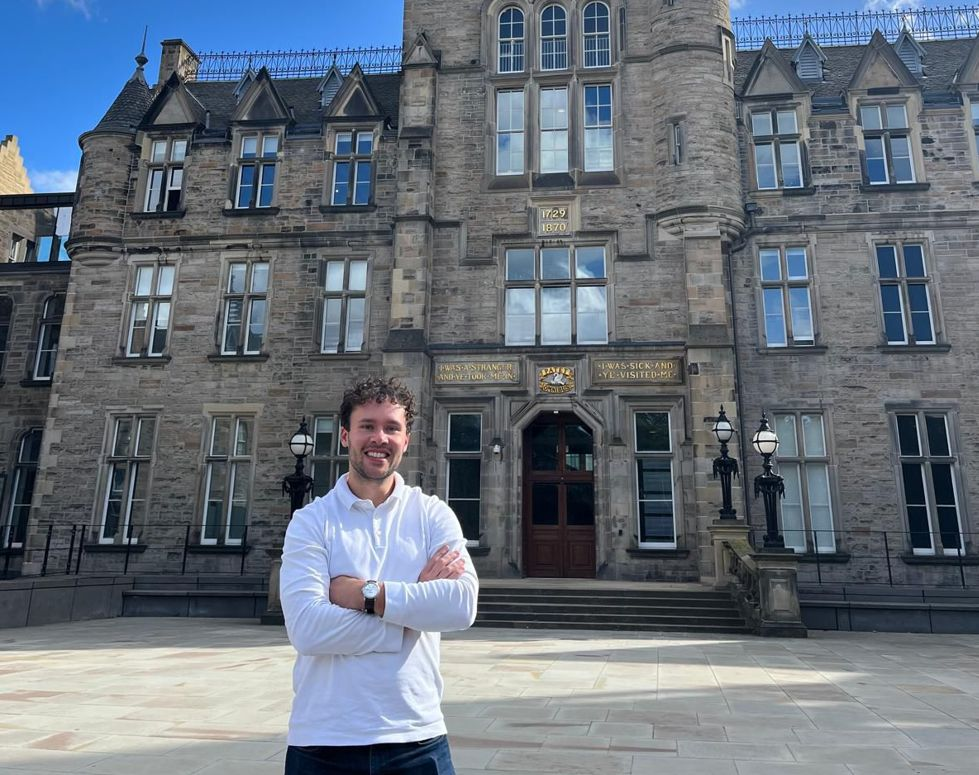
1. What is your background and area of study?
I am a Post-Doctoral Research Fellow in the School of History, Classics and Archaeology at the University of Edinburgh. My background is in personality psychology, in which I previously lectured at Edinburgh for two years. Personality psychology is concerned with how people differ in relatively stable patterns of thinking, feeling and behaving, and my own research has focused on antagonistic traits: characteristics that predict manipulative, exploitative and aggressive behaviour.
For my PhD, I developed a new psychometric measure of the Dark Triad of narcissism, psychopathy and Machiavellianism. I have since been working on taking personality research beyond questionnaires and exploring how we can measure these traits in naturalistic data, such as in the language found in social media posts. I am bringing this work to Weaponised Pasts to understand how individual differences in personality help to explain why some people are more likely to produce, or be more receptive to, hostile and exclusionary interpretations of the past.
2. What is your role in the project, and what expertise do you bring?
In Weaponised Pasts, my work focuses on collecting and analysing naturalistic data drawn from newspaper coverage of the past and its reception on social media. We are using computational text analysis to analyse millions of newspaper articles and social media posts to examine how certain presentations of historical and archaeological findings are associated with a greater risk of hostile interpretations of the past, and how these interpretations transform as they diffuse through social media.
I also bring my background in individual differences to the experimental strand of the project, where I will be contributing to our understanding of why the same historical information is interpreted in different ways by different people, such as how antagonistic traits may engender more hostile interpretations of stories about national identities and historical grievances. To date, very little work has examined how personality relates to interpretations of the past and how people connect the past to the present, and so this will represent a significant theoretical contribution to heritage and public archaeology.
3. In your view, what is the value of interdisciplinary research for understanding the emergence of hostility online?
Heritage-based hostility has significant consequences for individuals and society. It cannot be understood or mitigated by any single field of research, and so the interdisciplinary nature of Weaponised Pasts is one of the key reasons the project is so valuable. We are using personality psychology to explain why some people respond differently to the same material, heritage research to understand how and why particular versions of the past carry social and political meaning, cognitive science to understand the mechanisms through which the past can be distorted for present purposes, and cultural evolution to understand how those messages transmit and transform on social media. It is only by bringing these perspectives together that we can begin to identify and understand the causal mechanisms that underlie the spread of hostile interpretations of the past.
4. What are you hoping that Weaponised Pasts will contribute scientifically and to society?
Weaponised Pasts offers considerable conceptual and methodological novelty for science, and will translate into clear, actionable impact for policy around public history, archaeology and heritage. I hope the project will help us move beyond simple predictor-outcome associations that focus on a single aspect of social media communication, such as the content of a message, the characteristics of a user, or the features of a social media platform. People and contexts are not interchangeable, and these features must be considered together to provide an integrated, comprehensive picture of how the past is weaponised for exclusionary ends.
Our findings will be used to inform archaeologists, historians, journalists and heritage practitioners about the risks associated with certain presentations of the past, and to make it easier for us as a society to discuss difficult or contested histories in a way that reduces the risk of hostility towards marginalised groups.